From digital to paper: Can pen-and-paper exams end NTA’s test turmoil and shape the future of JEE, NEET, and CUET? – The Times of India
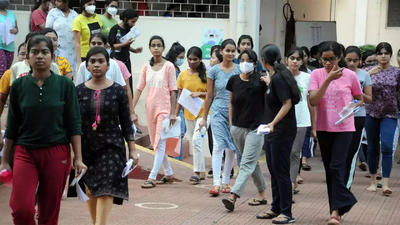
The parliamentary standing committee on education, women, children, youth and sports has recommended a stronger focus on pen-and-paper exams for major national tests, highlighting recurring disruptions in computer-based examinations conducted by the National Testing Agency (NTA). The committee, chaired by Congress MP Digvijaya Singh, reviewed the security, administration and financial functioning of the NTA in a detailed report tabled in Parliament.The report assessed 14 competitive examinations conducted by the NTA in 2024 and noted that at least five faced significant issues. UGC-NET, CSIR-NET and NEET-PG were postponed, while NEET-UG faced instances of paper leaks, and CUET (UG/PG) results were deferred. In early 2025, the report stated that in JEE (Main) 2025 held in January, at least 12 questions had to be withdrawn due to errors in the final answer key.Pen-and-paper exams and computer-based testingThe committee examined both pen-and-paper and computer-based test (CBT) formats. It found that pen-and-paper exams “offer more opportunities for paper leaks,” whereas CBTs “can be hacked in a manner that is difficult to detect.” Despite these concerns, the committee recommended a stronger focus on pen-and-paper exams, citing the proven reliability of CBSE and UPSC systems. It further advised that CBTs, when conducted, should only take place in government or government-controlled centres and “never in private centres.”Issues with vendors and administrationThe report highlighted ongoing problems with private vendors involved in paper setting, administration and correction. Several firms blacklisted by certain organisations or state governments continued to secure contracts elsewhere. The committee stated that “such blacklisted firms must not be engaged for any entrance test by the NTA or the state governments.” It recommended creating a nationwide blacklist of firms and associated individuals to prevent repeated involvement in exam-related malpractices.Financial review and capacity-buildingOver six years, the NTA collected an estimated Rs 3,512.98 crore and spent Rs 3,064.77 crore, leaving a surplus of Rs 448 crore. The committee suggested this corpus could be used to strengthen the agency’s capabilities to conduct tests independently, enhance regulatory oversight, and improve monitoring of vendors. Funding could also support better security measures for both pen-and-paper and computer-based exams.
Impacts of pen-and-paper exams
Implications for students and school curriculumA separate central panel has proposed reforms to reduce students’ dependence on coaching centres. It is considering conducting national exams such as JEE, NEET and CUET as early as Class XI. The plan aims to ease academic pressure in Class XII and limit daily coaching hours to two or three, down from five to six in many private centres.Officials said a hybrid assessment model could combine board marks with aptitude-based testing, strengthening classroom learning and internal assessments while reducing coaching reliance. NCERT has been tasked with coordinating with CBSE and state boards to compare Class XI and XII syllabi with entrance exam requirements, aiming to align school curricula and minimise disparities.Logistical challenges and exam conductTransitioning to pen-and-paper exams will require increased logistical efforts, including printing, secure transportation, invigilation, and manual evaluation. Despite these demands, pen-and-paper tests are expected to reduce technical errors, answer key issues and cyber vulnerabilities. Government-controlled centres and robust vendor oversight are considered essential to successful implementation.While the parliamentary committee did not mandate a full return to pen-and-paper testing, its recommendations emphasise the format as a reliable alternative. The decision on whether exams such as JEE Main, CUET and UGC NET will revert to pen-and-paper will depend on the government’s response and implementation of the committee’s findings.