Not Dennis Lillee or Malcolm Marshall: When Richard Hadlee bowled Sanjay Manjrekar to become first bowler to take 400 Test wickets | Cricket News – The Times of India
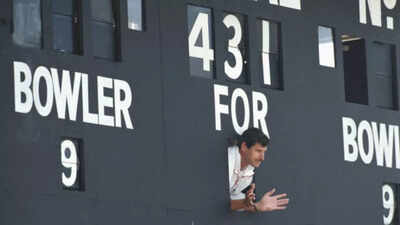
By the end of the 1980s, Test cricket had already seen great fast bowlers, long spells, broken bodies and careers affected by workload. What it had not seen was certainty that one man, alone, could push the limits of what was thought possible for a bowler in the longest format. Richard Hadlee was quietly moving towards that edge.New Zealand cricket, for much of Hadlee’s career, lived with that reality. They did not have depth in numbers or a long production line of stars. What they had was Hadlee. He bowled with the new ball, returned with the old one, and often did the work of several players rolled into one. By 1990, he was 39, nearing the end of his international career, but still central to everything New Zealand did on a cricket field.The Test against India at Christchurch followed a familiar pattern. New Zealand built a strong base through batting, with John Wright playing an innings of control and patience. His 185, spread over nine hours, took the hosts to 459. India then walked into a situation they had seen many times before in that era: facing Hadlee with the new ball.Hadlee and Danny Morrison worked in tandem. India lost wickets steadily and were bowled out for 164. Hadlee finished with 3 for 45. Morrison took five. The follow-on was enforced.India showed more fight in the second innings. W.V. Raman and Manoj Prabhakar added 80 for the opening wicket. Raman reached 96, Prabhakar made 40. When Prabhakar was dismissed, Sanjay Manjrekar came in. He faced four balls.Hadlee bowled one that rattled the stumps. Manjrekar was out for four. It was a routine dismissal in the context of the match. In the context of cricket history, it was not.That wicket took Richard Hadlee to 400 Test wickets. No one had been there before. Not Malcolm Marshall. Not Dennis Lillee. Not Fred Trueman. Hadlee raised his arms and looked upwards. India were later bowled out for 296. Hadlee ended the innings with figures of 4 for 69, taking seven wickets in the match. Morrison took six. New Zealand were left with a target of two runs, which they chased without delay to win by ten wickets.The match itself was straightforward. The moment was not.Hadlee’s numbers already placed him among the greats. He had won matches almost on his own. He was also more than a fast bowler. With the bat, he could change games from the lower order, and that combination placed him alongside Ian Botham, Imran Khan and Kapil Dev as one of the defining allrounders of the 1980s.What made 400 different was not just the round number. It was the idea it broke. Years earlier, Fred Trueman had said of reaching 300 wickets, “Whoever does it will be bloody tired.” Hadlee, at 39, did not look tired. He looked in control. He would go on to take 31 more wickets before retiring later that year, finishing with 431 in 86 Tests at an average of 22.29. In his last game for New Zealand against England, he picked up a five-wicket haul, finishing with a wicket with his very last delivery.Muttiah Muralitharan and Shane Warne would make their Test debuts two years later. They would push the numbers far beyond what existed then. But on February 4, 1990, that future was unknown. Four hundred was uncharted territory.On February 4, 1990, cricket found a new ceiling.