‘India’s growth drivers firmly in place, banks cleaner than ever’: KV Kamath
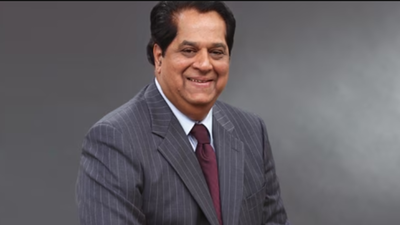
MUMBAI: Veteran banker KV Kamath is now the chairman of Jio Financial Services, helping guide its expansion in a crowded market. Kamath, credited with turning ICICI from a staid development financial institution into an aggressive retail powerhouse, remains upbeat on India and technology. Excerpts:PM Modi’s appeal to defer gold purchases and conserve fuel is seen as a call to prepare for difficult times. What is your reading of the situation?The 25-year growth trajectory towards Viksit Bharat remains intact. The underlying drivers—investment in infrastructure, urban transformation and the adoption of new technologies—continue to be firmly in place. These are structural in nature and are not easily derailed.At the same time, it is prudent on the part of govt to assess emerging headwinds in a changing global environment and calibrate the response. The impact of current disruptions on Indian citizens is relatively contained when compared with those in several other economies.
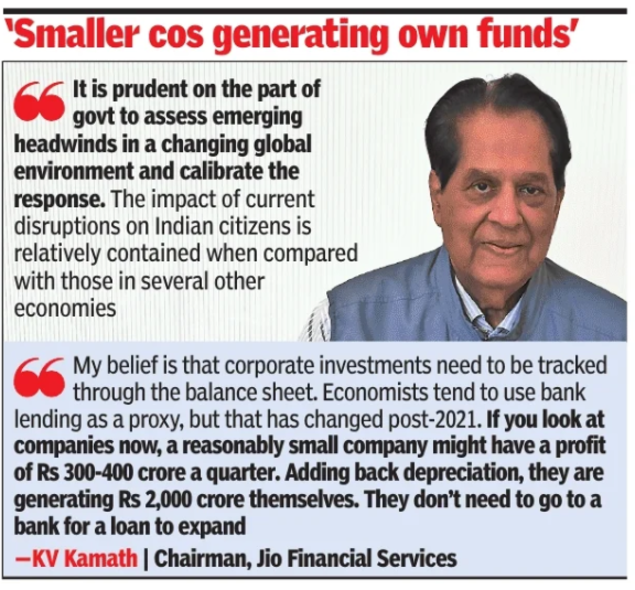
In this context, conservation assumes importance at two levels. One is efficiency in usage, and the other is the prudent management of foreign exchange.It is here that India’s macroeconomic strength—both in terms of growth momentum and reserve buffers—provides comfort and ensures that the growth trajectory is not unsettled.There will, of course, be near-term challenges, and these may persist until global conditions stabilise. However, they are unlikely to materially disrupt the broader growth path. The second dimension to watch is the impact on global production capacity and its longer-term implications. At this stage, there is limited visibility, and therefore a degree of caution is warranted.I would view the PM’s statement in that light—as a timely signal to sensitise citizens to the evolving situation and the need for measured, responsible action.Govt has plans for a high-level committee to look at reforms in banking. What are your thoughts on the road ahead?Six years back, post-Covid, Indian companies saw a huge jump in productivity and banks have cleaned up their balance sheets. I have never seen a banking system so clean in India and most parts of the world that I have worked in. Net non-performing assets, by and large, are less than 50 basis points. Mostly in the 25-35 bps level. You can’t ask for better. Your credit cost is virtually not there. One issue is to see how this strength can be sustained. Second, they will have to look at growth which means they should be able to raise capital efficiently. Third, is technology, the use of AI is going to redefine banking. The fourth area is inclusion and finally, the role of institutions as banks, NBFCs and new age players will evolve and their architecture will have to be defined so that it is efficient and stable.Are banks fleet footed enough to take on the challenge of the fintechs?From a global context, banks are built on legacy systems — software, which was appropriate at that time. But over time, it became a legacy. Some pieces are getting replaced as there was some movement to the cloud. But after the cloud, you had open source where a whole lot of things could be built. Then came Saas followed by digitechs building their own systems. Post 1990s, there are at least three or four waves which have been opportunities but it is only on the surface they have been internalised.Now in the last three to six months, we have the agentic wave. Today, for an institution to compete, you have to be native in what you are doing. Good news for India is, we have young people who can understand this.We have the people who can implement this and we frontline people who can handle it.When ICICI transformed from project finance to retail, a lot of the demand came from white-collar jobs in IT. Now we see that segment being disrupted by technology. Where will future retail demand come from?We used to say for every white-collar job created, there are four other jobs created. My view is that because of where we are on our journey, we may have a change in the mix of jobs. We may not have the white-collar jobs we had 25 years ago, but the growth path will require a whole lot of skills where you may wear ablue jumpsuit or a dark blue jumpsuit and not necessarily atie to go to work.People who will build India are needed. Our educational institutions need to see what skills are required and retrofit skills accordingly.How do you see the debate surrounding private investment not picking up?My belief is that corporate investments need to be tracked through the balance sheet. Economists tend to use bank lending as a proxy, but that has changed post-2021. A reasonably small company might have a profit of Rs 300400 crore a quarter. Adding back depreciation, they are generating Rs 2,000 crore themselves. They don’t need to go to a bank for a loan to expand. Most often, they are adding balancing equipment or increasing productivity. Unless it’s a massive greenfield project like a steel plant, they fund through cash flows. The real number to look at is the increase in Gross Fixed Assets and Capital Work in Progress year-over-year for all of corporate India. Corporate India has learned to live within its own four corners.